-
Informed Consent &
Malpractice -
Employment Litigation
ADA - Disability - Sexual Misconduct
Discrimination - Worker's Compensation -
Emotional &
Physical Damages
Conscious Pain & Suffering
Post-Traumatic Stress Disorder (PTSD)
Neuropsychiatric Autopsy - Standards for Experts
-
Product Liability
Medical Devices & Pharmaceuticals
Toxic Tort -
Criminal Justice &
Public Safety
Diminished Capacity - Drug Addiction
Competency to Confess
Death Penalty Mitigation
Workplace Safety - Family & Custody Issues
-
Testamentary &
Contractual Capacity -
Professional &
Organizational Ethics
Patient Care - Managed Care - Privacy -
Psychoanalysis &
Cultural Perspectives -
Loading
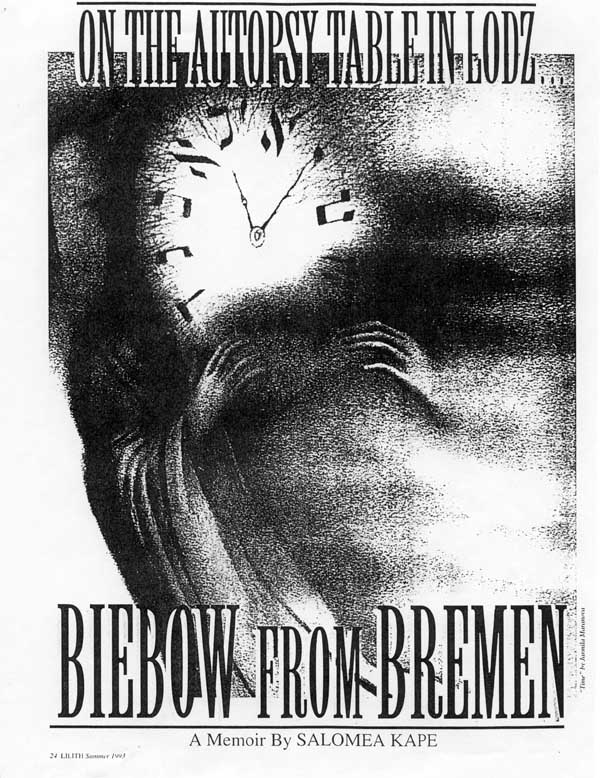
"Sally, come quick to the Anatomy Building."
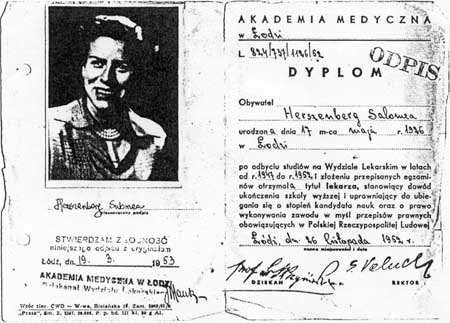
The excited voices of my Jewish friends reached me at chemistry class. Here I was in Lodz, in 1947, a first-year medical student absorbed in my studies of inorganic chemistry. Anatomy was far away, scheduled for next year, but there was some urgency in the voices, and I asked impatiently. "What's going on?"
"Come and see for yourself." answered Sarah, a girl I knew well from the years spent together in the Lodz Ghetto. Reluctantly I left the lab.
As I entered the Anatomy Building, the smell of formalin hit my nostrils and caused a coughing spell, but through the tears I saw a naked body on the table. The skin was leathery, yellowish, covering a rather small body of a middle-aged man. Brown hair draped the skull and thin, purple lips formed a straight line on this rather unremarkable face.
"Sally," Sarah said triumphantly, "take the scalpel and start the dissection of Hans Biebow."
HANS BIEBOW!
I looked at the exposed body again. The narrow forehead, the shape of the jaw, were the sole remainders of Hans Biebow, the man who liquidated the Jews of Lodz.
Is it the same Biebow, the tall, blond beast straight from Nietzsche's description of a German "Ubermensch?"
Is it Biebow, the six-foot-tall Wagnerian god in shiny black boots, whip in hand?
What happened to the golden hair, the cold blue eyes? That's how I remember him as he stood on the podium during the eradication of Lodz Ghetto in the summer of 1944. I was then eighteen.
"Meine Juden," my Jews, he called us. The July sun highlighted the blondness of his hair, embossing it in gold. "Leave the Ghetto voluntarily. At the railroad station in Marysin, trains are waiting for you. I shall relocate you to the West where there are better living conditions for you, good work, and more food. Take with you all your personal belongings and don't forget the pots and pans."
"The pots and pans"—a simple and deceiving phrase, for if pots are needed, there must be food in the West!
Where did Biebow learn the psychological trick of mentioning small homely details to give the deportation an air of normalcy? He had vast experience liquidating smaller Jewish ghettos around Lodz and deception always worked. But only the naive truly believed the gilded giant who put himself on a pedestal to tower over a crowd of Jews in rags, their bodies ravaged by hunger. He was a Siegfried from a Beggars' Opera.
I was among the crowd of listeners, and when the sun caressed Biebow's blond head I felt that God had abandoned us and had joined the company of Biebows.
The Russian troops stopped their advance on the east bank of the Vistula river, 75 miles from Lodz. The forces of war played against us. During the summer months, Biebow sent the remaining eighty thousand Jews from Lodz straight into the ovens at Auschwitz. The pots and pans were neatly collected in Auschwitz and sent to German hausfraus. "Let's go to the railroad station," I pleaded with my mother, who was the driving force of my family in the Ghetto. "The Gestapo already have started their Actions and they will remove us by force."
My mother, barely five feet tall, didn't agree with me, nor did she believe in Biebow's "pots and pans."
"I prefer to stay and die in Lodz. I don't know where they are sending us," was her answer. Later in the summer, however, she took my father and me to Baluter Ring, a square in the Ghetto where selections were made.
There Biebow was choosing a cleaning commando of six hundred Jews to remove what was left of his kingdom called Litzmannstadt Ghetto—the name he had given to Lodz. The Ghetto was for Biebow a gold mine, a Klondike—as well as a shelter from the dreaded Eastern front.
Now Biebow made his final selection, and, with a jerky movement of his whip, he sent people to the right or left. His ice-cold, sky-blue eyes looked at my thin mother, my swollen-from-hunger father, and—without glancing at me—he pushed us with the end of his whip to the left, where children, sick-looking, and old people were already waiting. We went obediently to the left, but when Biebow turned to the next line, my mother quickly pushed us back to the right.
I was assigned work in a stable, helping to clean the horses which were needed for transportation around the remains of the Ghetto. Biebow was a frequent visitor, and he often came to the stables with his eight-year-old son.
"Papa." cried, the little boy, "the horse is dirty." I knew that Biebow would call the manager of the stable and beat him until his back was a bloody pulp. No matter how we cleaned the horses, the little boy always found a dirty spot. I hated the horses, the blondness of father and son. I wondered why we called the lowest human instincts of hatred and violence "dark" forces when they should be called "blond" ones.
Biebow was an attentive and loving father, and with the utmost patience he taught the little boy to shoot the few birds flying over the Ghetto. It was the first time I saw him as a father, a person, which was a revelation to me. For me he was a non-person, a death machine. Sometimes I wonder what happened to the little boy. Does he carry the sadistic genes? Does he remember the bloody massacres performed by his father in Lodz Ghetto?
A half century later, I ask my Lodz Ghetto friend Esther, who recently visited Bremen (Biebow's native city). if anyone there remembers the Biebow family. Hans was a well-known businessman there. "Do you remember his little shopping bags distributed in the Ghetto?" I ask Esther. "They said, 'Hans Biebow, Coffee Export, Bremen.' There must be somebody in Bremen who knows of the son, who remembers the family."
"I asked many times," answers Esther, "but nobody has ever even heard of the name."
And so the name disappeared from the annals of the city, a small name in the history of Nazi Germany, not a Hitler, a Mengele, or a Himmler, but for us—the former inhabitants of Lodz Ghetto—a name synonymous with the destruction of the Jews of Lodz.
Selections continued, and always a group of Jews were taken from the morning role call and sent to a death camp.
On the other hand, almost every day a group of people were found in some hiding place and joined us in the camp. There was no need to waste bullets on these Jews—sooner or later the cleaning of the Ghetto would be over. and the final solution for the tiny remnant of Jews would take place as a mass execution by the prepared grave in the Jewish cemetery.
But in one of the hiding places, in a cellar, Biebow encountered resistance.
Dr. Daniel Weiskopf, a Ghetto doctor who didn't have medications for his patients and who looked on with despair as they died of starvation and rampant tuberculosis, wounded Biebow with the only weapon he had in his hand—a knife. Before he was killed he told Biebow, "Murderer, blood of innocent people is on your hands! Your days are numbered!"
Daniel Weiskopf's last hour was his finest; he died a free man. His death shook the camp, and the white dressing on Biebow's blond head was for us like a flag of freedom; a monument to the brave doctor.
Biebow was not the same man after Weiskopf's death. Maybe he was haunted by the murdered doctor's prophecy as well as horrified by the thunder of Russian cannons. He was now often drunk and would appear suddenly in the middle of the night and order some young girls to undress, observing them in a drunken stupor. He didn't rape them but he took a perverse pleasure in looking at the naked bodies and the fear in the girls' eyes. Here he was, in the middle of the night, the hangman of Lodz Ghetto, finding his life pleasures in the thin, naked bodies of Jewish girls.
We greeted the New Year of 1945 with hope and joy, seeing masses of Germans running west with their belongings. They fled in cars, on foot, in bicycles, pushing each other into the gutter in their "Drang nach Western [drive to the west]." The air of superiority was gone and so was the blondness; an odor of defeat emanated from their bodies. Panic changed their Aryan faces to a sweaty, fear-stricken physiognomy; also gone was the proverbial German law and order. I enjoyed the winter landscape in Lodz in 1945 very much. The Russians were ante portas [at the gates], but our camp was still guarded and the mass grave was waiting for us. The thunder of war was music to my ears, a modern, powerful, "1812 Overture." It was also a belated celebration of Christmas with all the lights in the black sky resembling a giant, cosmic Christmas tree. The sky at night was criss-crossed with arcs of fire; we heard the roar of Russian Katyushas, violent explosions that shook the earth, eerie displays of light and sound.
We survived because Biebow happened not to be in Lodz at that moment, and his deputy—rather than executing the mass—was busy taking care of his own life. Biebow would have been much better organized. The spirit of Daniel Weiskopf dominated the camp, his heroic death opening for us a new dimension in life. Thus we knew that in the absence of guns, a knife, a bat, a piece of heavy iron might be a weapon too. We knew that every one of us could defend herself, and nobody—but nobody—was too young or too old to do so.
In 1947, two years after the end of the war, Biebow was caught in Germany and brought to Poland for trial in Lodz. I went for one court session and I saw a pitiful figure alone on the bench, pleading "not guilty."
"Daniel Weiskopf," I talked in my head; "your murderer has been brought to justice, but my pain, the pain remains. Forever, Daniel, forever?"
"I don't want the knife, Sarah. I don't start anatomy until next year," I said numbly to my friend.
I returned the scalpel to her, and, without taking a second look at the corpse of Biebow, I left the building. Revenge is not in my vocabulary, only the pain of moral victory.
Salomea Kape is a retired 66-year-old physician, specializing in anesthesiology. She came to the United States in 1966 and lives in Brooklyn, NY.
Questions or comments, please contact the Web Developer


